Case Study: 40% Less Admin Time in 60 Days
- Liz Vargas
- November 14, 2026
- Uncategorized
- 0 Comments
Case Study: How a Growing Service Firm Cut Admin Time 40% in 60 Days
Most service firms don’t have a lead problem. They have a follow-up problem wearing a lead problem’s coat. This service business marketing case study walks through one engagement end to end – what we found, what we built, and what actually moved in 60 days – so you can judge whether the same playbook fits your firm. Client details are anonymized, but the numbers, timelines, and sequence are real.
The starting point: leads coming in, follow-up falling through
The firm was a 14-person accounting and advisory practice with recurring revenue and a healthy referral stream. On paper, marketing was working. Their site ranked for a handful of local queries, referrals kept arriving, and the phone rang most weeks.
Then we looked at the middle of the funnel.
Inquiries arrived by email, by form, and by text to whoever’s cell number happened to be on the site. Nobody owned the follow-up. The same lead got two calls from two people, or zero calls because it was a busy Tuesday. Quotes went out as PDFs and then quietly died in someone’s drafts folder. Nobody could answer a simple question: how many opportunities are open right now, and what’s the next step on each?
Their intake process was, functionally, memory. And memory doesn’t scale past about five people.
The website wasn’t helping either. It was a brochure – nice enough, but static, slow on mobile, and built to describe the firm rather than to route a prospect toward a consultation. There was no tracking, so nobody could say which pages produced a single inquiry, let alone a signed client.
That combination – visible lead flow, invisible leakage – is the most expensive pattern we see in professional services. You’re paying to generate demand and then losing it in the gap between “inquiry” and “booked.”
What changed: website, SEO, and automation in one build
We didn’t run a rebrand, a six-month content sprint, or a new ad budget. The RISE Growth System is three connected pieces, launched in one sequence because each one makes the others measurable.
Phase 1: A site built to route, not just describe
Weeks 1-2 were structural. We rebuilt the site around service pages that answer a searcher’s actual question, then connected them to a single consultation path. One form, one calendar, one confirmation message. No competing phone numbers, no “contact us” dead ends.
Every inquiry now enters the same intake flow, which means every inquiry is visible. That alone changed behavior – when follow-up is observable, it happens.
Phase 2: SEO grounded in what the firm actually sells
Weeks 2-6 focused on the queries that produce consultations, not the vanity terms. We mapped service pages to real search intent – the specific, unglamorous phrases a business owner types at 11pm when they’re worried about a deadline – and fixed the technical layer underneath: speed, mobile rendering, internal linking, clean metadata.
This is the part most firms skip because it doesn’t produce a screenshot you can post. Six weeks in, organic impressions were already climbing on pages that had previously ranked for nothing.
Phase 3: Automation for the follow-up nobody has time for
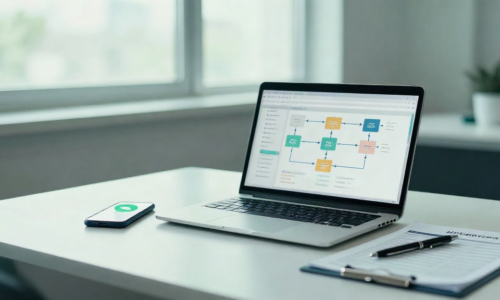
Weeks 3-7 were the real unlock. We built the client journey in their CRM: instant acknowledgment on every inquiry, qualification questions, self-serve booking, reminders before the call, no-show recovery, and a structured sequence for quotes that haven’t closed.
The follow-up stopped depending on someone remembering. Every opportunity got a next step and a visible stage, and the ones that stalled got reactivated automatically instead of being rediscovered three months later.
The results at day 60
- Admin time on intake, scheduling, reminders, and quote follow-up dropped roughly 40% – close to two full working days per person per month returned to billable work
- Response time to a new inquiry went from “same week, usually” to under 5 minutes, automatically
- Every open opportunity became visible in one pipeline view, with no more leads living in a personal inbox
- Organic traffic and impression volume rose on service pages that had previously earned nothing
- The firm closed opportunities it would have lost silently in the old process, because the no-show and stale-quote sequences caught them
The headline number is the 40%. The number that matters more is the one nobody can put in a dashboard: how many inquiries the old process dropped without anyone noticing.
The repeatable playbook for other service firms
Here’s the part that generalizes. Nothing in this build was specific to accounting – the same sequence works for law firms, consultancies, agencies, medical practices, and any business that sells through a consultation.
- Pick one path to a conversation. One form, one calendar, one owner. If a prospect can reach you four ways, you can’t measure any of them.
- Fix the site around search intent, not around your org chart. Pages answer questions. The homepage sells the next step.
- Instrument before you automate. You can’t improve follow-up you can’t see. Get every inquiry into one pipeline first.
- Automate the boring five. Acknowledgment, qualification, booking, reminders, and stale-quote follow-up. That’s where the admin hours live.
- Give it 60 days before you judge it. Weeks 1-2 are structure, weeks 3-7 are build, and the last two weeks are when the compounding starts to show.
What to do with this
If you read this service business marketing case study and recognized your own firm in the first section – steady leads, inconsistent follow-up, and a website nobody can attribute a client to – the problem is almost certainly fixable inside a quarter, not a year.
Start by answering one question honestly: if a qualified prospect inquired today, could you name every step between that message and a signed agreement? If the answer involves “usually” or “it depends who sees it,” you’ve found the 40%.
Five Spots builds the RISE Growth System for professional service businesses – web development, SEO, and automation, done for you, with the 60-day window and the 40% admin reduction as the target rather than the promise-of-the-month. If you’d like to see what that looks like for your practice, book a consultation and we’ll map the gap before you spend anything.
Related Posts